Home / Services / Forest to Bog Restoration

From standing trees
to living bog

Our complete forest to bog system — one contractor, one mobilisation, taking afforested peatland all the way from commercial conifer crop to a finished, functioning restored peatland.

Why Forest to Bog

Two disciplines.
Usually two contractors.
Not here.

Thousands of hectares of the UK's deep peat were planted with commercial conifer in the last century. As those crops mature, the drainage and root action beneath them continues to dry the peat — releasing carbon and degrading habitat that can take decades to recover.

Returning these sites to functioning blanket bog is a complex, technically demanding process that spans two very different trades: commercial forestry and peatland restoration. Most programmes split that work between contractors — with all the interface risk, double mobilisation and divided responsibility that brings.

Owen Environmental does both, in-house. The same team, the same low ground pressure fleet and the same management systems carry the site from first tree to final bund.
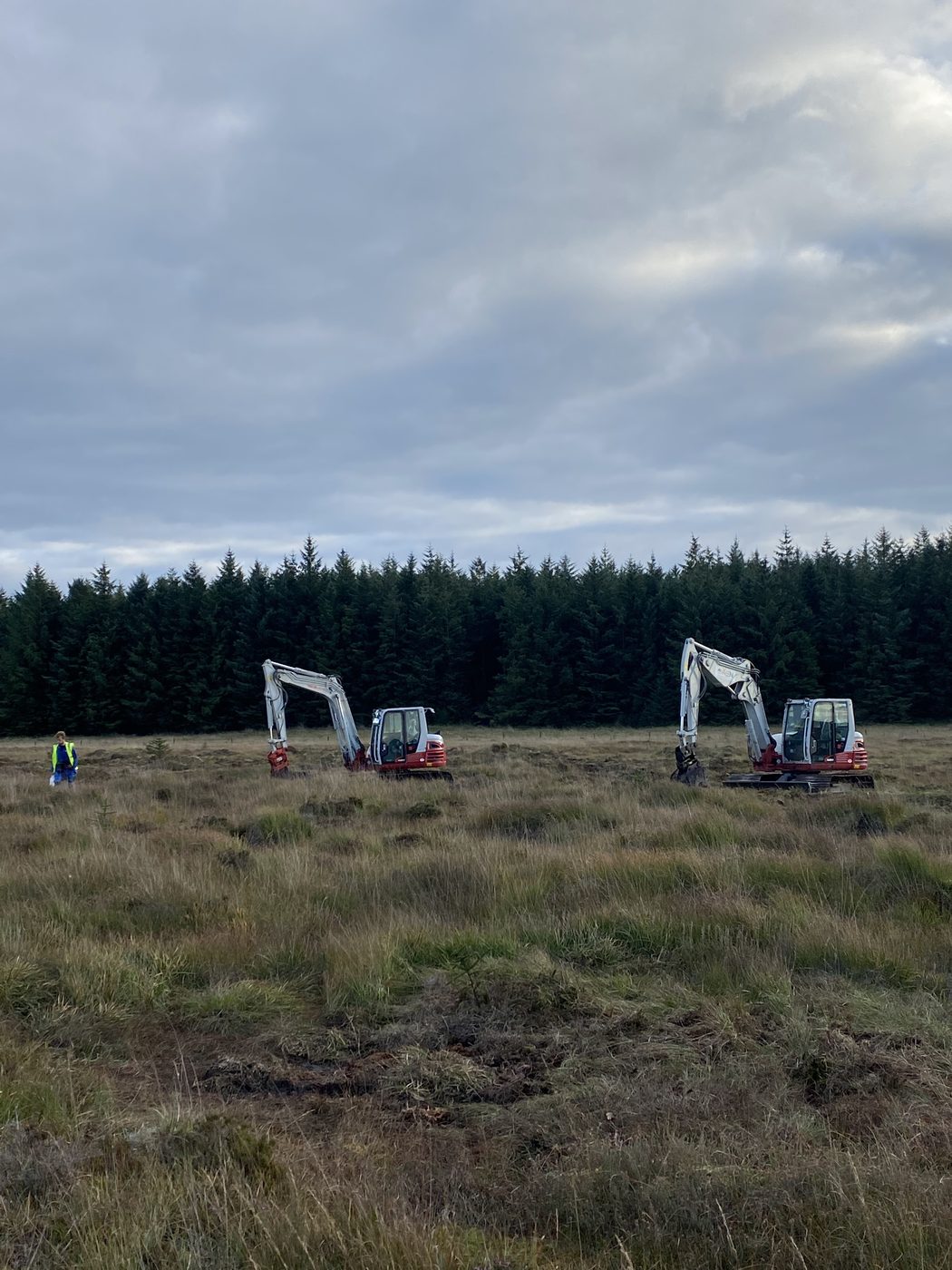
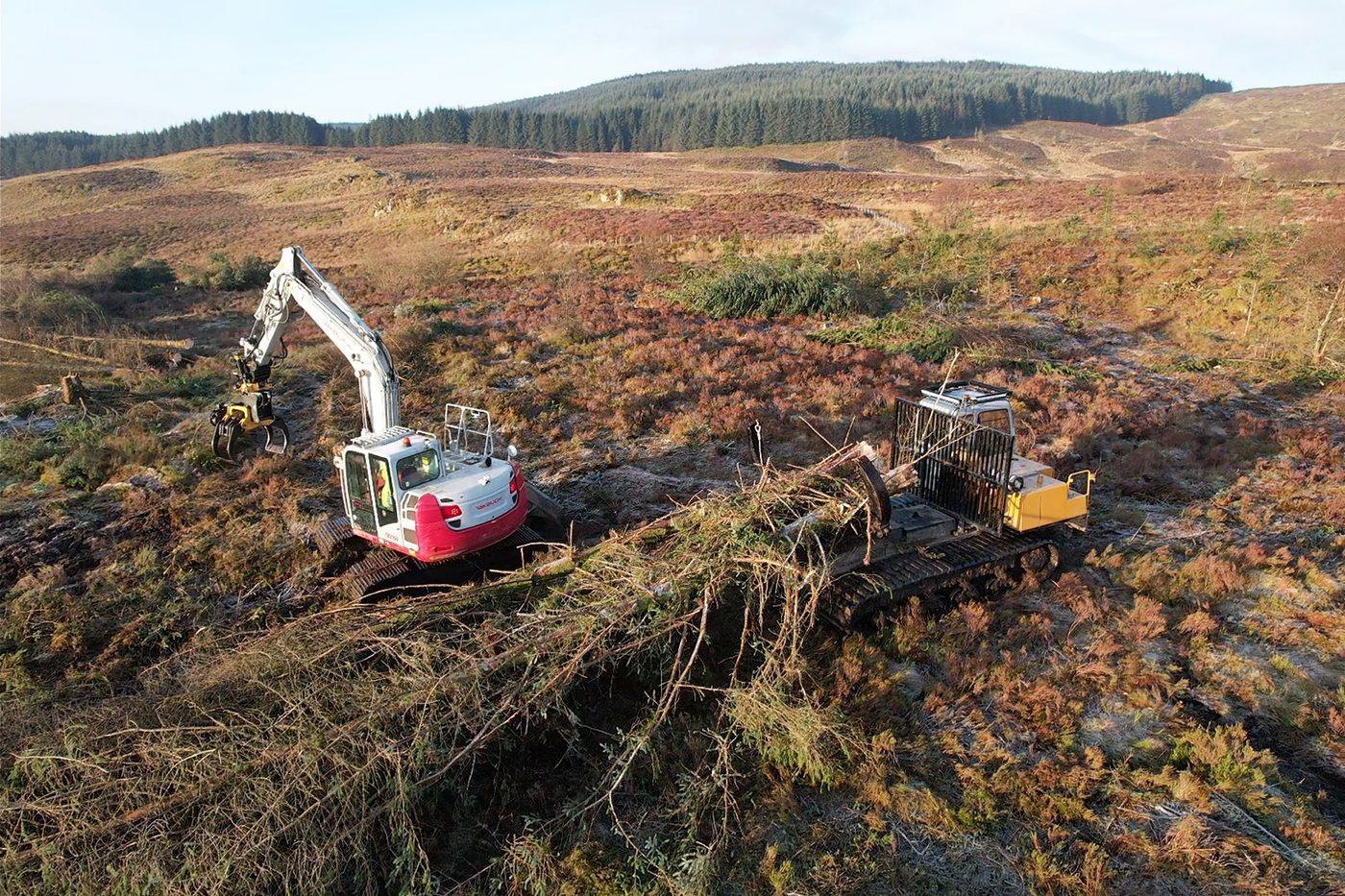
Low ground pressure excavators working at the forest edge

The System

One continuous process,
four stages

Tracked clam bunk being loaded with whole trees

Stage 01 — Whole-Tree Felling & Extraction

Tree shears and clam bunk — trees out whole

Excavator-mounted tree shears cut the standing crop whole, tree by tree, from a low ground pressure base. Our tracked clam bunk then carries the trees out complete — clamped and lifted clear, not dragged across the peat.

  • Multi-tree handling shearing head for fast, controlled whole-tree felling
  • Tracked clam bunk carries whole trees off the restoration area — no dragging, minimal surface disturbance
  • Timber and biomass value recovered from the crop helps offset restoration cost
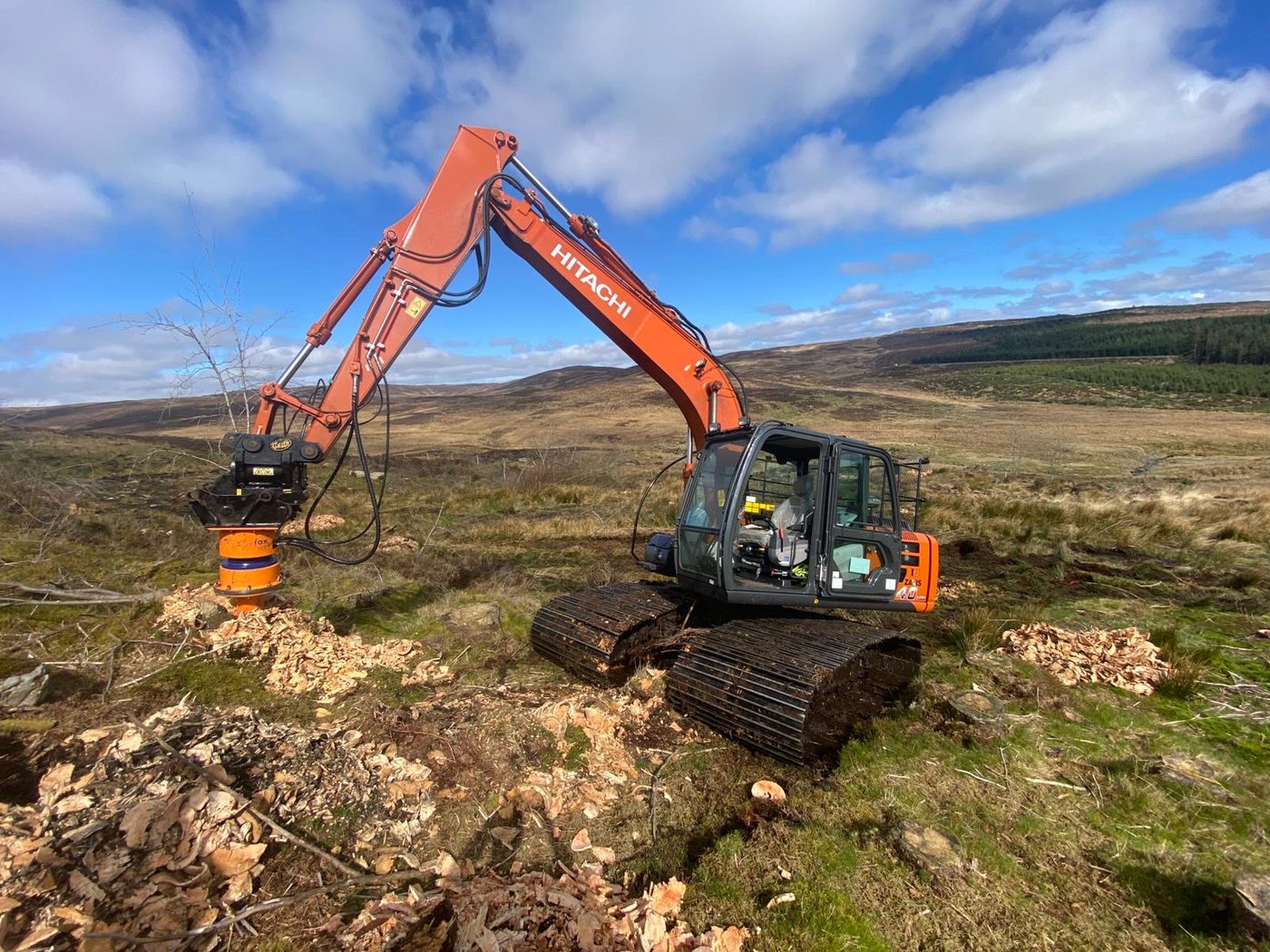
Dipper Fox stump grinder working on former plantation

Stage 02 — Stump Treatment & Ground Smoothing

The Dipper Fox stump grinder

Instead of ripping stumps from the ground, our Dipper Fox stump grinder — the orange-and-blue bladed attachment — grinds each stump out in place. The difference matters: almost all of the vegetation around the stump is retained, so the peat surface stays intact and ready to rewet.

  • Stumps ground in place — no upturned root plates, no bare peat scars
  • Almost all surrounding vegetation retained, accelerating the site's recovery
  • Furrows and plough lines smoothed to re-establish natural surface flow
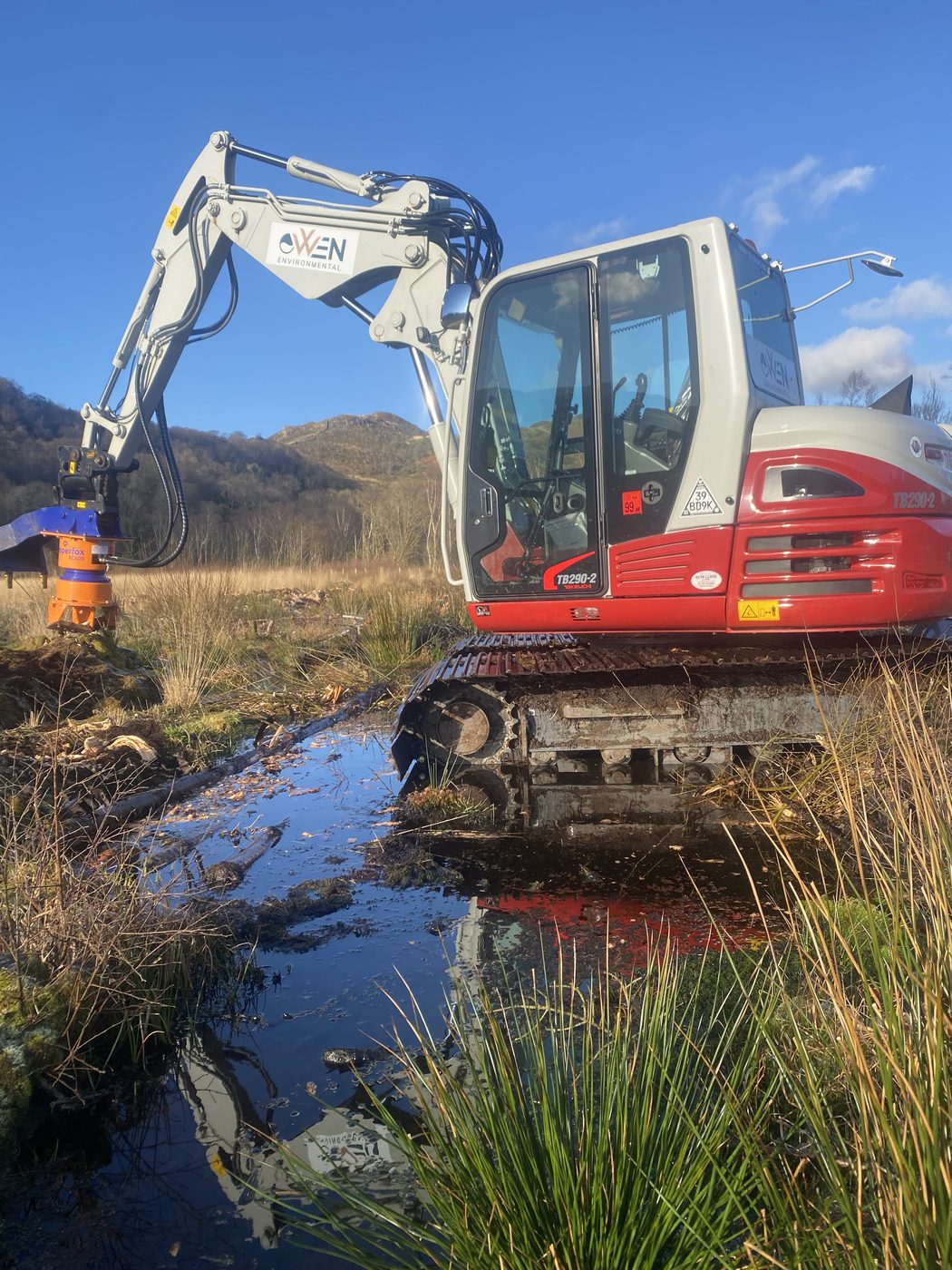
Water table restored — excavator standing over open water on rewetted bog

Stage 03 — Rewetting & Re-profiling

Restoring the hydrology

The full peatland restoration toolkit is then applied: drain blocking, wave damming, zippering, contour bunding — including the interlocking cell bunding method we developed at Lake Vyrnwy — and hag reprofiling to stable gradients.

  • Bunds formed from peat won on site and sealed with intact vegetation
  • Techniques proven across programmes exceeding 1,000 Ha in a single season
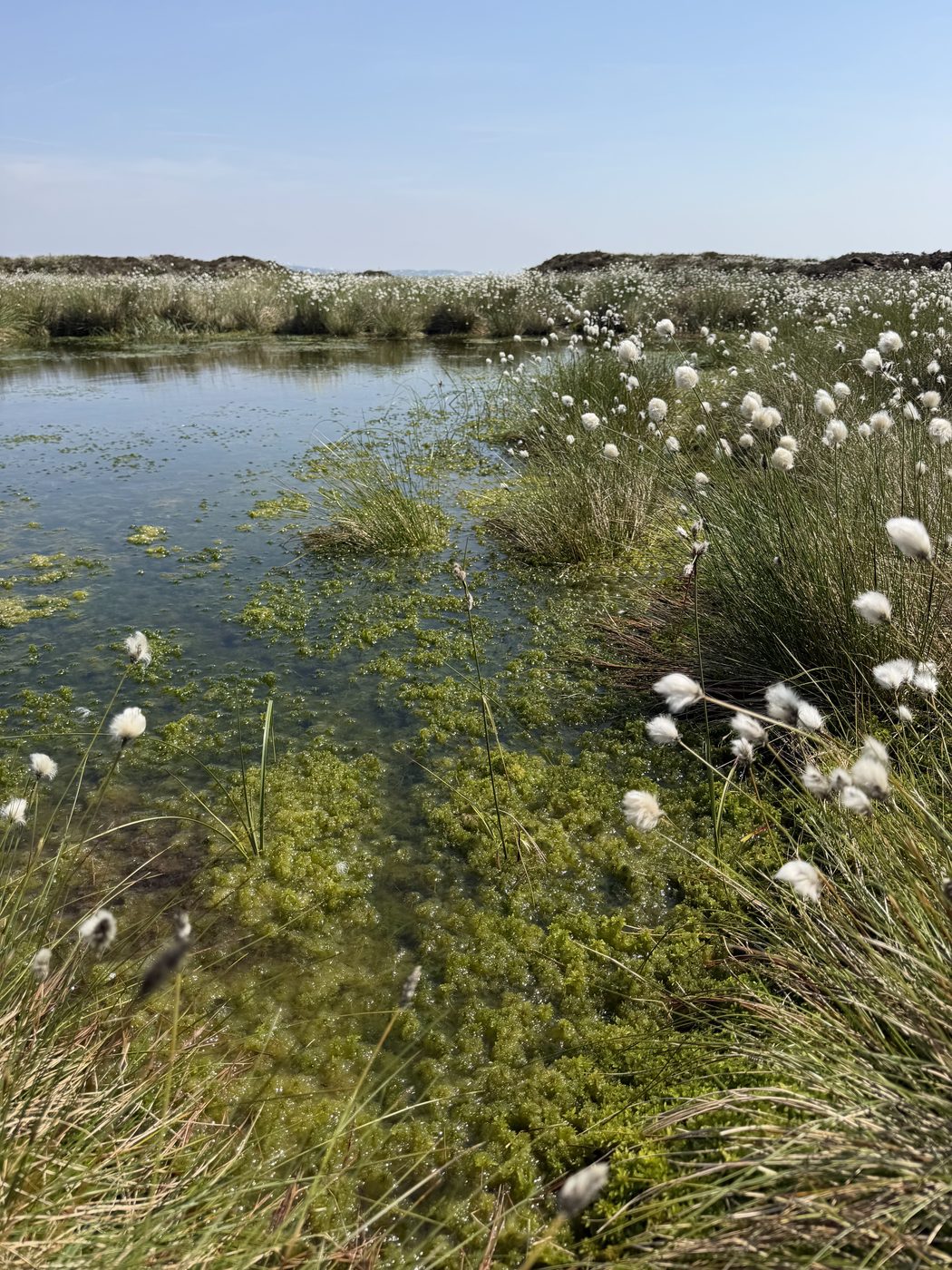
Cotton grass recolonising a restored bog two years after works

Stage 04 — The Finished Site

A functioning blanket bog

With the water table raised and the surface re-profiled, the site is handed back as a functioning peatland — pools re-forming, sphagnum recolonising, carbon locked back into the ground.

  • Clean integration with the surrounding peat body
  • Delivered within programme, budget and environmental compliance requirements
1
Contractor, first tree to final bund
60 Ha
Former Sitka plantation restored at Bryn Fawnog
2
Trades delivered in-house — forestry & peat
0
Contractor interfaces to manage

Proven In The Field

Bryn Fawnog, Lake Vyrnwy

Appointed by RSPB Cymru, we returned a 60-hectare former Sitka spruce plantation on the Lake Vyrnwy reserve to functioning blanket bog — working through winter conditions on a remote upland site.

Stump grinding, ground smoothing and a full programme of peat interventions including contour bunding and hagg reprofiling, delivered as one continuous operation.

See Our Peat Restoration Work

Why It Works

The case for one contractor

Single mobilisation and one set of environmental controls across the whole programme — no handover gap between felling and restoration.
No interface risk between a forestry contractor and a restoration contractor — one point of responsibility from start to finish.
Timber and biomass value recovered from the crop helps offset restoration cost.
The same low ground pressure fleet and certified operators throughout, minimising ground disturbance at every stage.
Delivered under ISO 9001 and ISO 14001 UKAS-accredited management systems, with directors involved throughout.

Afforested Peatland To Restore?

One call covers the whole job

From standing trees to a finished, functioning bog — talk to us about your site and we'll walk you through how the system would apply.

Get in Touch